
Last year, at the Second Congress of the World Writers' Organization in Moscow, we spoke of a new ethics of creativity and set the bar very high. A year has passed. Many of us took it as a writer should. A writer bears ethical responsibility for their work in general, and especially in the present time. But the main thing — a reassessment of values — still lies ahead. Yet already today, poets and writers everywhere are holding actions and flash mobs for peace, for the preservation of human civilization, for the preservation of planet Earth. How much do people listen to the voice of the creative person? And whether this voice is among the decisive ones — that is hard to judge. But one thing is certain: this voice must, against all odds, remain independent, and only then will it serve the good of humanity.
The Word stood at the beginning of the creation of the world. But today the Word has not lost its purpose.
The Word is one of the principal and most powerful instruments of creativity and creation. And today it is needed more than ever.
But it has seemingly lost its force — the timbre has weakened, the sound has faded, and most importantly, the meaning. It lacks the living fire, the divinity of the creator, that would make people stop, turn around, listen, and take this word into their hearts. I believe that the word today lacks novelty as well. Not only the fresh wind, the whirlwind, the storm — there is no movement at all. There is no high love for what has already been created with great dignity and respect for the human being. The word today is like a prisoner, locked inside flat human feelings, fleeting desires and needs. Almost no past remains in the word. There is no future. And only a dead field after the consumer's harvest shines with the abyss of human barbarism toward planet Earth — our only home.
The word is powerless not because the world has gone deaf. But because we ourselves speak, write, and manifest one thing, while living by habit, by words, by laws written not by us.
One can endlessly throw stones at the impenetrable walls of greed, silver-lust, and gold-lust. But throw at least one stone at yourself first.
Kill the barbarian and the mindless consumer within yourself before anything else.
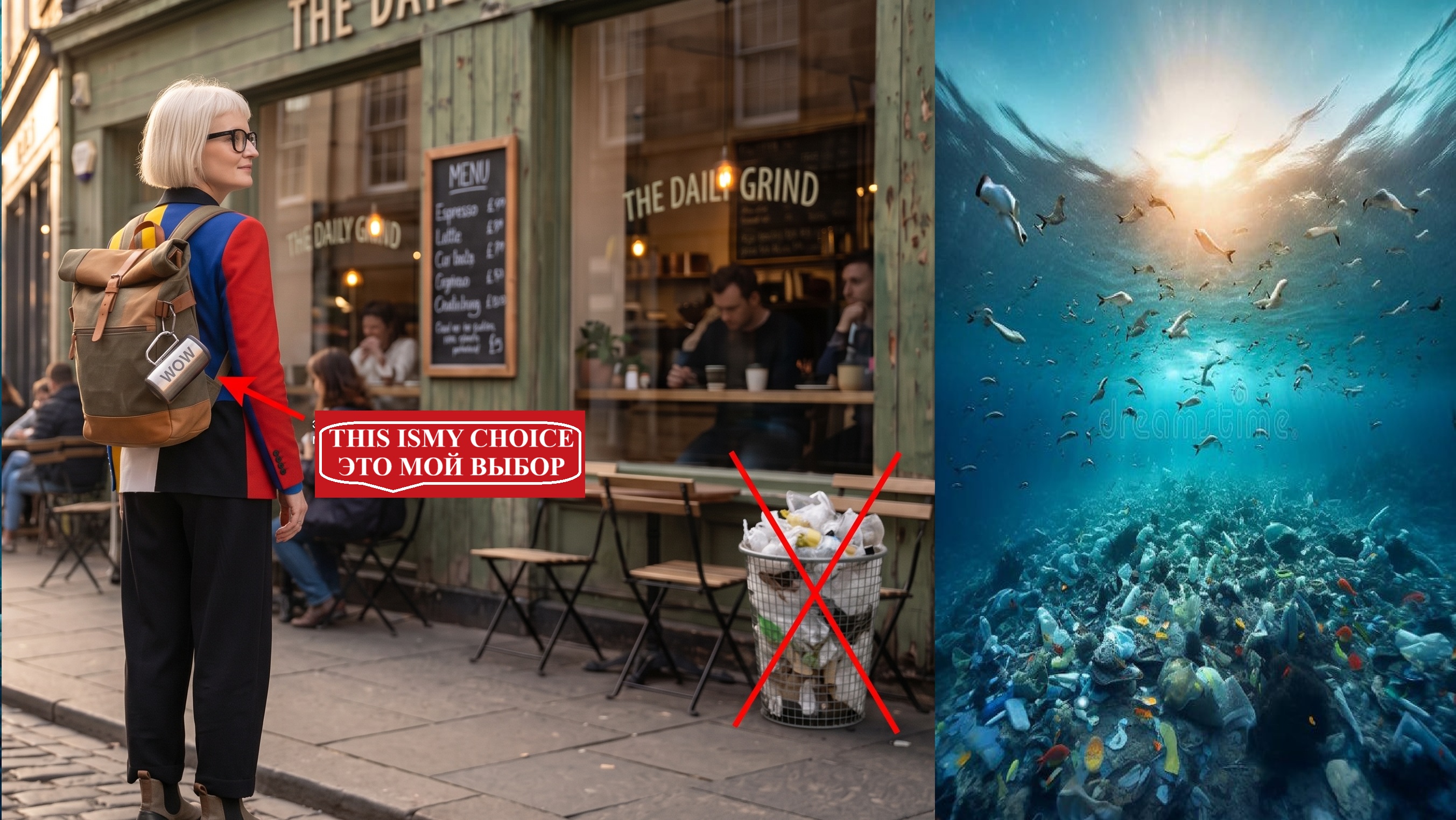
Give up forever the plastic cup you drink your coffee from — carry your own mug. And if everyone does this, then in a single day one and a half billion disposable cups will not be needed. Plastic does not die — it changes form. In the ocean it becomes microplastic that returns to us with fish, with salt, with water. It is found in Arctic ice and in the placentas of unborn children. We do not see it because the cup is pretty and convenient, and the ocean is far away. And how much food we throw away. About a billion tons a year — nearly a fifth of all food available to consumers. In landfills, food rots and releases methane — a gas that traps heat twenty-eight times more powerfully than carbon dioxide. Food waste accounts for 8–10% of global greenhouse gas emissions — nearly five times more than all aviation. This food could have fed 1.26 billion people. And I could cite millions more examples of human madness in the name of comfort.
And as a result — environmental pollution kills 9 million people a year. This is tens of times more than all wars and violence combined.
And this is not only the greed of the silver-lovers. This is primarily us. The poor, the destitute, the people of modest means. We are billions. And it is we who every day make the small choice that, in sum, has become an abyss.
Today each of us is a special kind of writer. And today especially, one must not only write about this, but live up to one's own manifestos.
With respect,
President of the World Writers' Organization
Margarita Al
September 8, 2026


